
Pronunciation: /dĭ-skrēt′/
Adjective
-
Constituting a separate thing.
Example: "Computers treat time as a series of discrete moments rather than a continuous flow." -
Consisting of unconnected distinct parts.
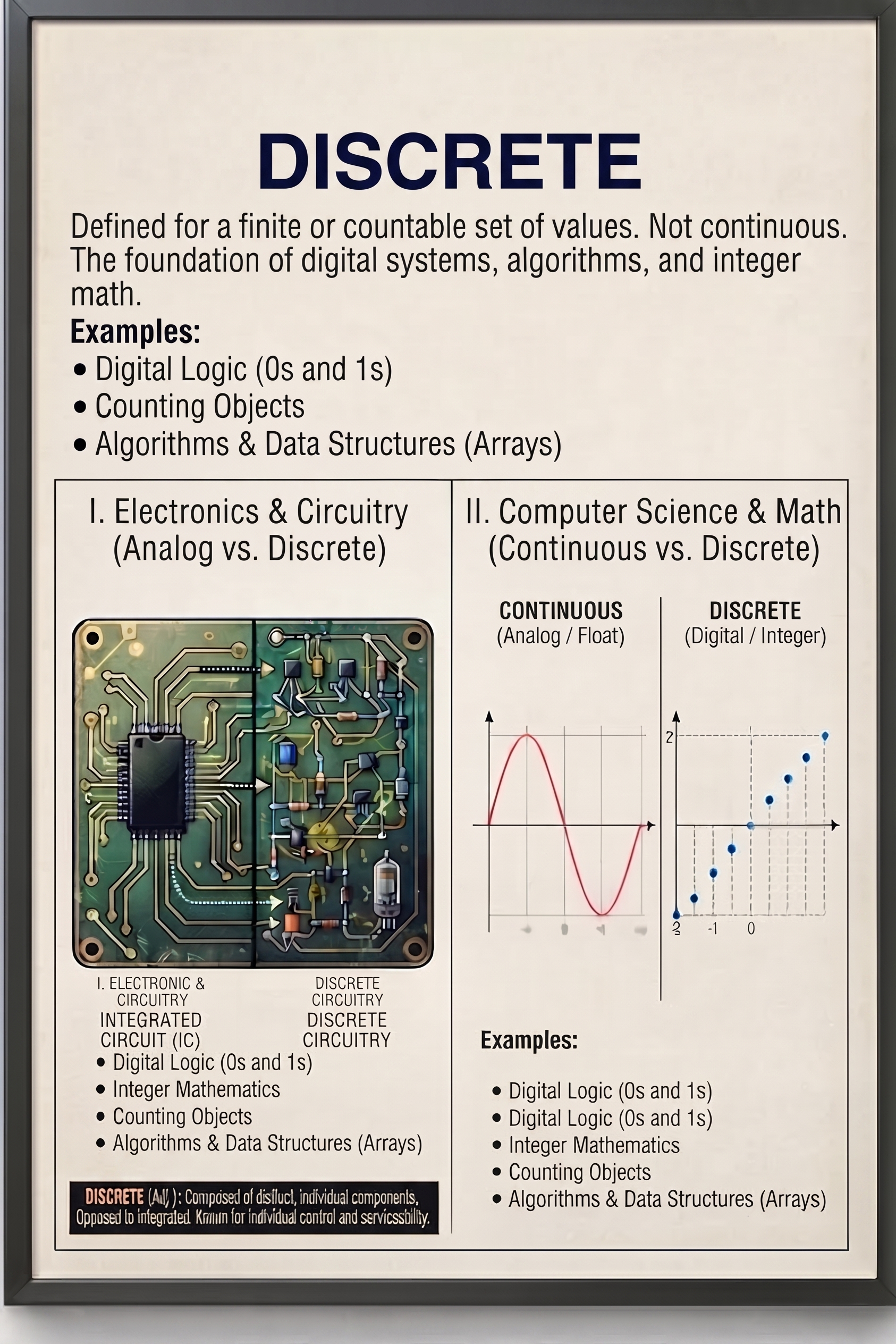
Example: "Society viewed as a discrete whole of individual agents." - Defined for a finite or countable set of values; not continuous.
- Separate; distinct; disjunct.
-
Disjunctive; containing a disjunctive or discretive clause.
Example: "“I resign my life, but not my honor,” is a discrete proposition." - Separate; not coalescent (said of things usually coalescent).
-
Proportion where the ratio of the means is different from that of either couplet.
Example: As in 3:6::8:16, where 3 bears the same proportion to 6 as 8 does to 16, but 3 is not to 6 as 6 is to 8. This is opposed to continued proportion (e.g., 3:6::12:24).
Transitive Verb
- To separate.
Source: The American Heritage® Dictionary of the English Language, 5th Edition • More at Wordnik
See also: Related concept on Wolfram Alpha