
Exchange‑Traded Funds (ETF)
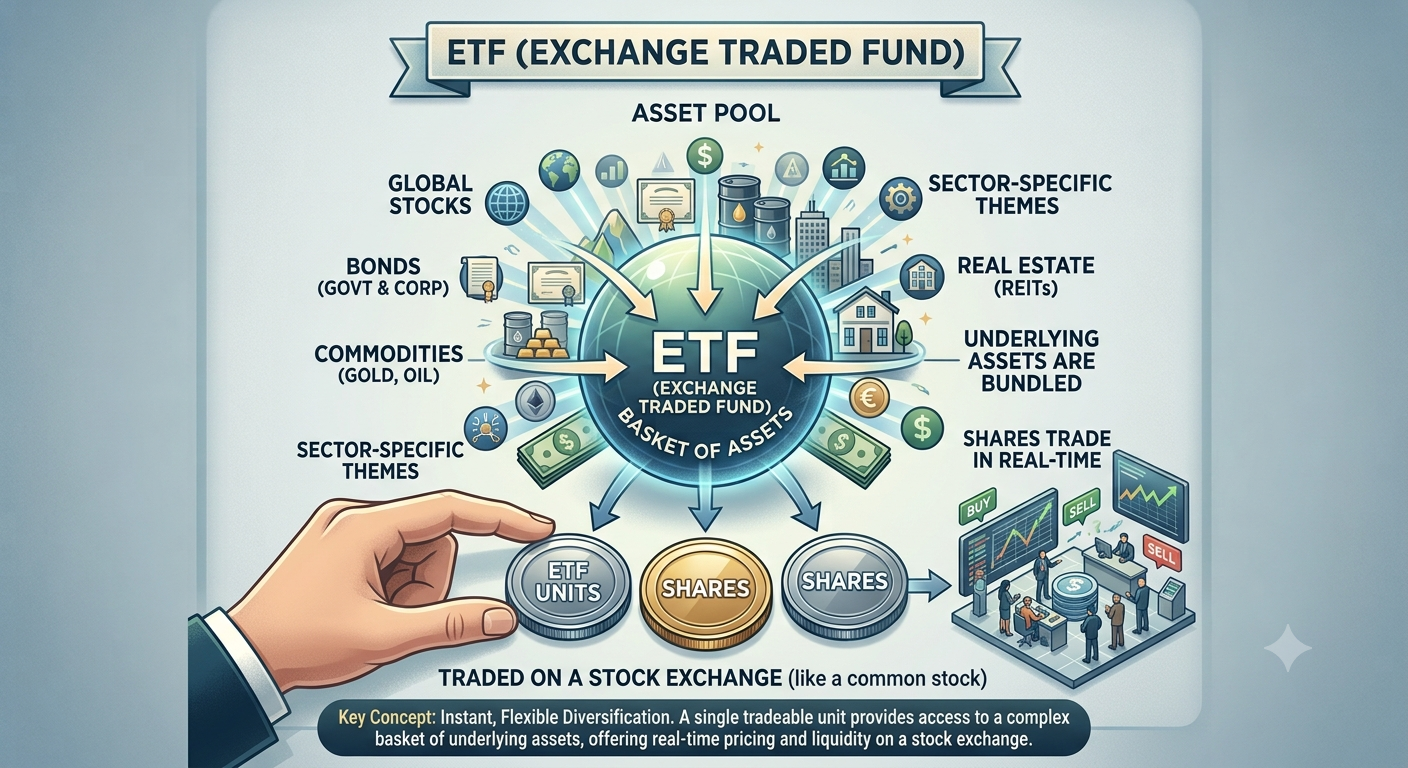
An Exchange‑Traded Fund (ETF) is a basket of investments—like stocks, bonds, or commodities—that you can buy and sell on a stock exchange just like a regular share.
ETFs are popular because they offer instant diversification, typically low fees, and the flexibility of real‑time trading. Instead of picking individual stocks, you buy one ETF and get exposure to an entire market segment.
Candidly: ETFs are the “set‑it‑and‑don’t‑stress‑it” tool of modern investing. They’re built for people who want broad exposure without micromanaging every position.
See also: Related concept on Wolfram
| Section | Label | Visual Motif | Text Summary |
|---|---|---|---|
| [BUNDLED ASSETS] | Stocks, bonds, commodities | Three icons feeding into a central ETF block | ETFs combine multiple asset types into one tradable unit. |
| [EXCHANGE TRADING] | Market ticker, arrows | Exchange board with buy/sell arrows | ETFs trade like stocks — instant liquidity and transparency. |
| [DIVERSIFICATION] | Pie chart, shield | Circular flow showing risk spread | One ETF gives exposure to many holdings, reducing single-stock risk. |
| [LIQUIDITY & FLEXIBILITY] | Clock, mobile trade icon | Real-time trading loop | Buy or sell anytime during market hours — unlike mutual funds. |
| [COMPOUND ACCESSIBILITY] | Growth chart, tree cluster | Echoes DRIP’s compound growth section | ETFs simplify long-term accumulation through diversified exposure. |